

What Is a Prediction Market?
Prediction markets are platforms where users can bet on the outcomes of future events by trading contracts.
Because participants have financial incentives to be accurate, market prices tend to act as real-time probabilities on whether an event will occur.
Today, prediction markets have upwards of $700m in volume, representing positions across sports, current affairs, politics, pop culture, crypto and more.
How Do Prediction Markets Work?
Prediction markets are financial markets designed to aggregate information about future events. A bit like the markets you know and love, but instead of trading stocks, commodities or crypto, you trade contracts — whose price depends on whether a specific outcome occurs or not.
Here’s the key concept: prices act as probabilities. It’s perhaps best to illustrate this with an example of a market with two possible outcomes, YES and NO.
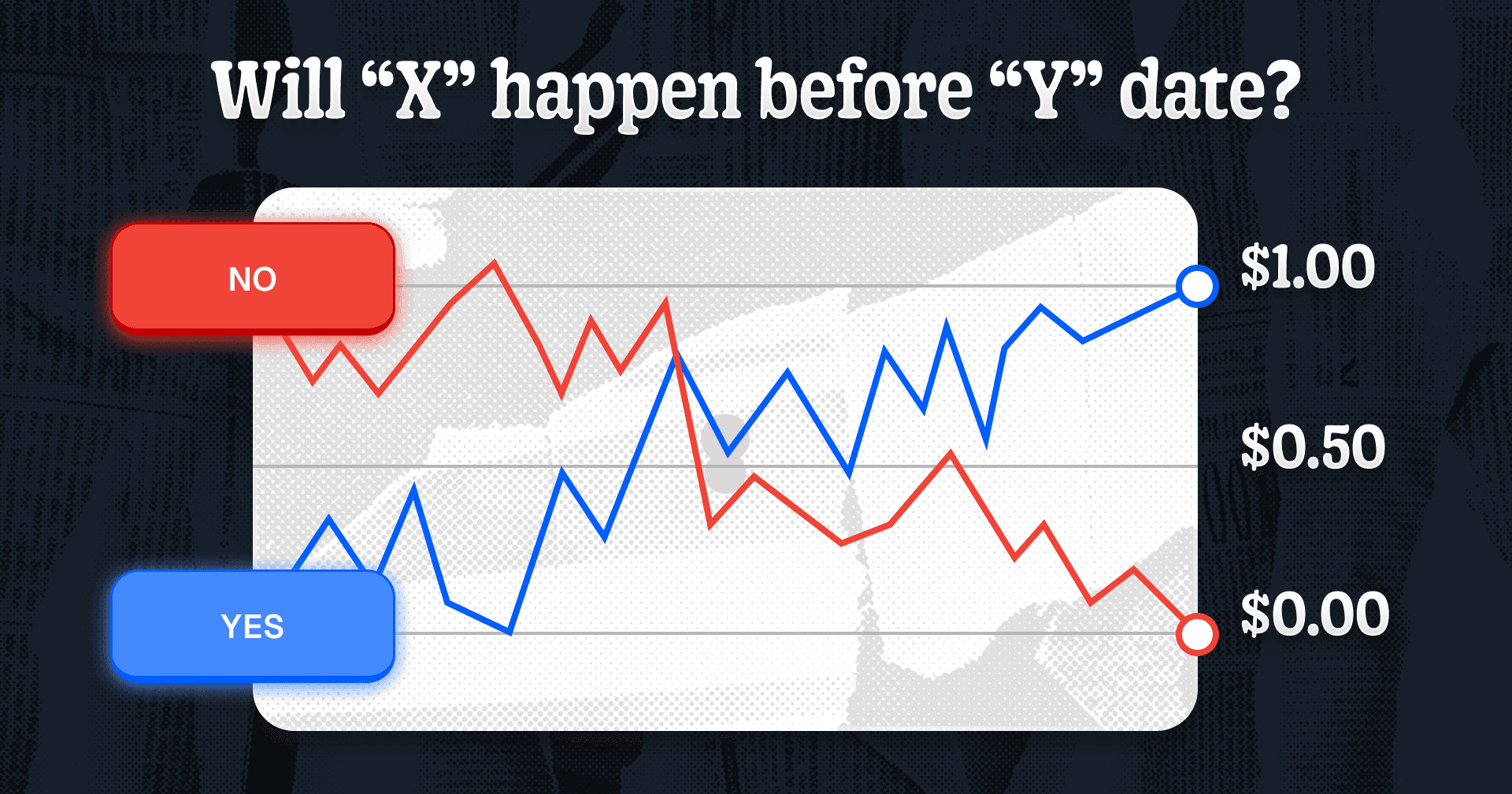
Above is how this market's chart might look. For a yes/no question, there are only two possible answers:
- If the answer is YES when "Y" date occurs, YES contracts will be worth $1.
- If the answer is NO, then NO contracts will be worth $1.
This is a zero-sum game, so whichever answer is wrong will be worth $0. Meanwhile, the winning contracts can be redeemed on the prediction market platform for $1.
What about markets with more options?
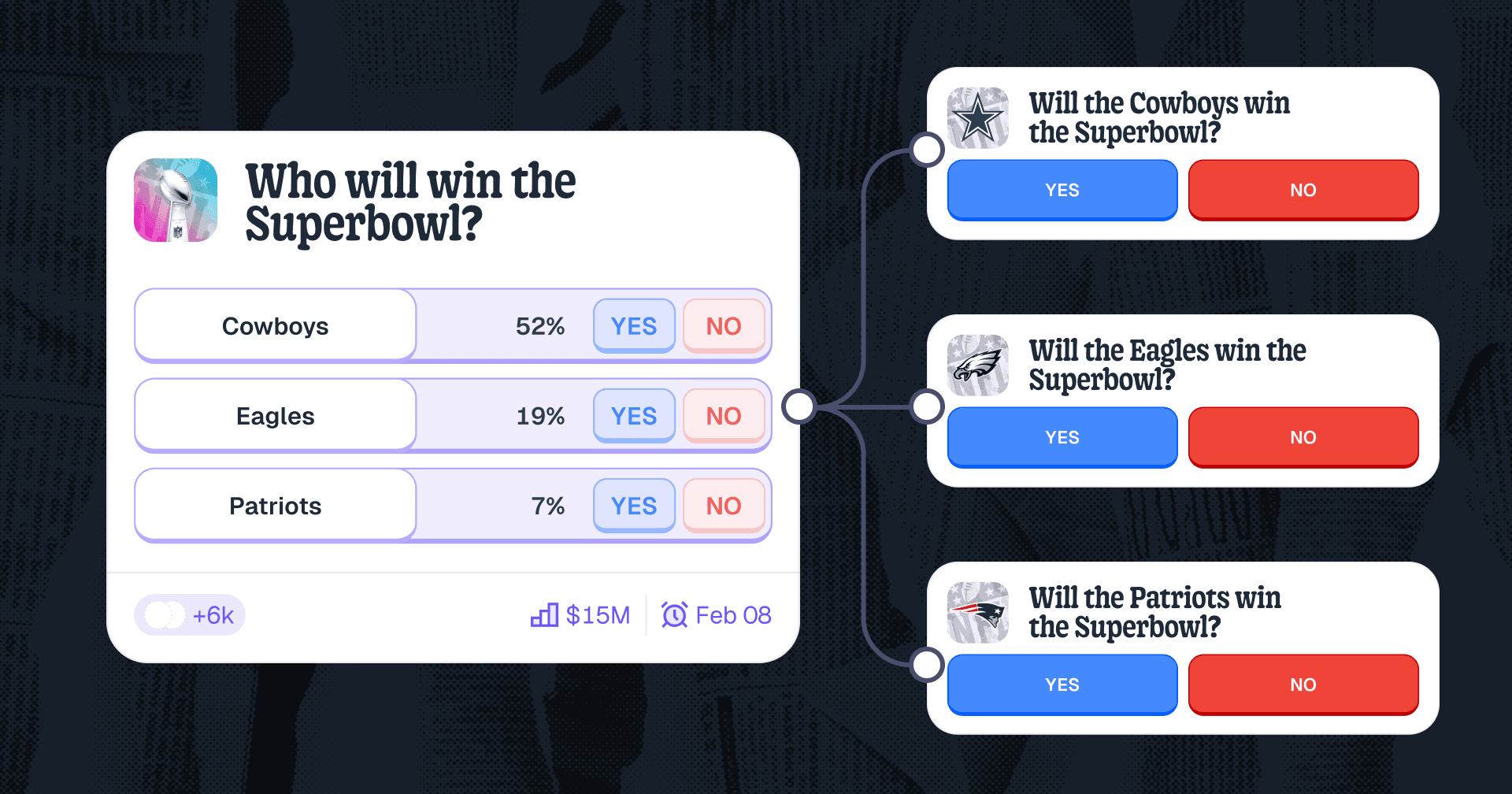
Believe it or not: they're still just YES/NO markets — only grouped under the same umbrella.
For example, a Who will win the Superbowl? market doesn't treat the Cowboys, the Eagles or the Patriots as options. Rather, these are three distinct markets formulated as Will {team} win the Superbowl?
To which, of course, the answer remains YES or NO.
Why is the contract price fluctuating?
Because the market isn't certain about the answer.
In our chart, we see a market that resolves YES — but, in the beginning, YES contracts were trading at $0.20, while NO traded at $0.80.
Because of the binary nature of these markets, the value of YES + NO will always equal $1.
YES trading at such a discount signifies that market participants believe it has a low probability of happening. Specifically, they believe there’s a 20% chance of it happening. On the other hand, they believe NO has an 80% chance of happening, which is why it trades at $0.80.
We see this change over time. Usually, because new information has come to light, such as breaking news or poll results being released. Over time, we see the price of YES contracts increase, which signifies that the market views the outcome as increasingly likely to occur. In lockstep, NO decreases in value as it looks less likely.
As market expiry looms, we reach a point where there’s a 90% chance of a YES resolution. Buying YES contracts at this stage will result in a much smaller yield ($0.10 on every contract), because the market is essentially saying this is highly likely to happen. It’s therefore a low-risk play.
If you were to buy NO contracts here at $0.10, your reward would be much higher ($0.90 on every contract) — but the market tells us this is highly unlikely to happen, so it’s a high-risk play.
Wisdom of the Crowds
You may be wondering how the “market” is able to accurately set probabilities.
Let’s take a step back and remember that the “market” is actually a vast group made up of individuals and institutions, each with varying knowledge — pieces of a puzzle, if you will.
In a sufficiently large market, that's a huge amount of people bringing a fragment of information to the table: insider knowledge, professional expertise, private research, different methodologies for interpreting data, even intuition. They're financially incentivized to put the right information to use: good information is rewarded, while bad information is penalized.
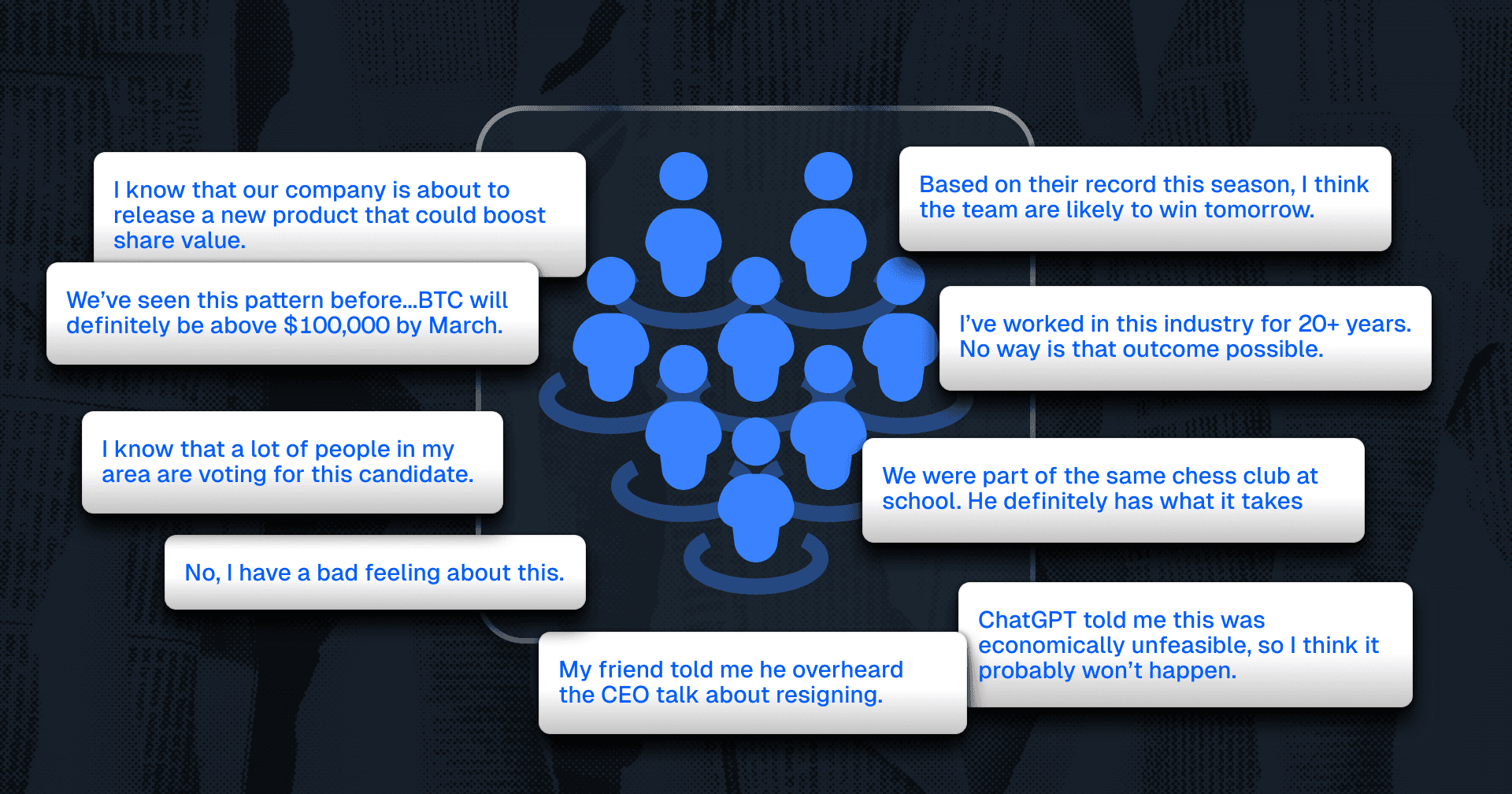
On their own, these individual fragments may have no value (they may even be incorrect). But amass thousands, tens of thousands of them, and you begin to create a composite image. This is what we call the wisdom of the crowds.
As participants aim to act on the information they have, the markets update in real-time.
A History of Prediction Markets
Prediction markets are a hot topic in 2026 - owing primarily to the popularity of Shayne Coplan's Polymarket. It began to grab mainstream headlines during the time of the 2024 US presidential elections, with its Presidential Election Winner 2024 market accruing over $3.5 billion in volume.
While critics suggested that interest in these information markets would dry up following the election, it certainly doesn't appear to be the case: in January 2026, total volume across platforms like Kalshi, Polymarket, Predict, Probable, Myriad Markets and many more.
However, the story begins much earlier than 2024.
"Political betting" has been recorded as early as the 1500s, with individuals betting on the outcomes of papal conclaves.
Even at this time, the practice was considered "old".
1988: The Iowa Electronic Markets (IEM)
Perhaps one of the earliest modern examples, Iowa Electronic Markets (IEM) launched during the 1988 presidential elections in the US by the Tippie College of Business.
A non-profit initiative, the IEM is more of a research project than a consumer-facing betting site. It bills itself as a "small-scales futures exchange", and places a $500 cap on investments. As well as winner-takes-all resolutions (winners receiving $1 per contract and losers receiving nothing), it also has vote-share resolutions: where the payout would be proportional to the share of the vote a candidate receives. For instance, if Candidate A received 62% of the vote, contract holders would receive 62c.
The IEM remains in operation today, though its limitations (in investment/number of markets) do not position it as a serious platform for predictors seeking to turn a profit.
2000s: Intrade and PredictIt
After the IEM came a new wave of more consumer-focused "betting" platforms, somewhat closer to today's prediction markets.
Based in the Republic of Ireland, Intrade was launched in 2001 (to be later acquired by TradeSports in 2003). Prior to its suspension of all markets in 2013, it enabled users to bet primarily on winner-takes-all markets in categories such as sports, politics, the economy, and current affairs.
Intrade attracted publicity in 2003 when its market pertaining to the capture of Saddam Hussein's capture/killing saw a spike in volume, days before the Iraqi dictator was apprehended by American forces.
Did an insider turn confirmation information into profit? History doesn't repeat, but it often rhymes.
Like the IEM, PredictIt is a non-profit initiative, run by the Victoria University of Wellington in New Zealand - though it's available only to US users. Launched in 2014, it faced some back and forth with regulators, with the CFTC rescinding a no-action letter in 2022. However, as of 2025, it has full regulatory approval, and is expected to release an expanded platform without its previous restrictions (e.g., caps on investments and limiting users per market).
2010s-2020s: The blockchain revolution
The current era of prediction markets is largely defined by the use of blockchain-based protocols and oracles.
The now-defunct, Ethereum-based Augur can be credited with leading the charge back in 2018, following an ICO in 2015. While on the surface appearing to function similarly to its predecessors, this was a whole new breed of prediction platform: one that wasn't controlled by a single, centralized entity, and where anyone could create their own markets via smart contracts.
With this approach, a new method for resolutions is required - in other words, the process of determining the outcome for a given event. This isn't difficult with the centralized approach: the decision is down to a single entity (the operator).
In decentralized setups, it's considerably more difficult, as that information needs to be relayed to the underlying blockchain. For this, prediction markets use an oracle.
An oracle is a bridge between a blockchain and the outside world, responsible for bringing real-world data on-chain - e.g., weather forecasts, election results, stock prices.
These can be decentralized (requiring some clever dispute resolution mechanisms) or centralized (having an intermediary process for publishing the data on-chain).
Today's platforms have come a long way from Augur's architecture, chiefly due to:
- Being built on faster chains (or layer 2s)
- Using automated market makers (AMMs)
- Offering gasless trading
- Relying on simpler oracles
Many of today's top prediction markets use some combination of these things (Polymarket, Predict, Opinion). Interestingly, however, the leader by volume (Kalshi) is fully centralized, with no blockchain aspect.
Ready to Make Your First Prediction?
Join thousands of traders making smarter predictions every day.
Let's GoFrequently Asked Questions
Why are prediction markets considered accurate?
It’s assumed (in a sufficiently liquid market) that all traders are bringing private information or specialized knowledge to the table. Correctness (not confidence!) is rewarded, meaning that participants are quick to update their beliefs as new data becomes available.
When such a wide range of individuals share their information in this manner, it creates a constantly-evolving composite image of a future outcome that updates in real time, making them more up-to-date than polls or surveys.
Why do people use prediction markets?
Prediction markets are primarily used by traders to turn information they hold into profit.
However, much like the stock market, the information generated as a result can be incredibly helpful across a range of domains. Since market prices effectively act as probabilities, they’re used by news organizations, economists, political analysts and more to inform decisions, policies, etc.
What is an oracle in prediction markets?
When a prediction market expires, it must be resolved: a decision on the outcome has to be made, which will allow traders holding the correct outcome to redeem every contract for $1.
Blockchain-based prediction markets are not connected to the outside world, so they need to have the information fed to them via a "bridge" — which is what an oracle is. The oracle is the mechanism that determines the real-world outcome and feeds it into the market in order to settle the contracts.
An oracle can be centralized (meaning it is a single trusted entity who uploads the data to the blockchain) or decentralized (using financial incentives to have a network of users reporting honestly on outcomes).
Are prediction markets gambling?
In a legal sense in some jurisdictions, prediction markets may be considered gambling. However, from a conceptual point of view, they aren’t.
On the surface, it’s easy to mistake it for chance: money is being risked on uncertain events, not unlike a betting platform. However, in a prediction market:
There are no “odds” set by a bookmaker – the market decides on pricing.
There is no “house” with an edge.
Predictions are made based on knowledge and information, not luck.
Prediction Market Glossary
Prediction market
A venue for trading, where participants buy and sell contracts whose value is tied to the outcome of future events.
The price at which contracts trade reflect the probability of the outcome occurring.
Contracts
A contract (or "share"), in the context of a prediction market, is a tradable instrument whose value depends on the outcome of the market.
For example: Will Candidate X win the election? has two contracts: YES and NO.
If Candidate X wins, the YES contract can be redeemed for $1. If they don't, then the NO contract can be redeemed for $1.
Market resolution
A market resolution happens when the market has come to an end, and the official outcome is decided upon.
When the real-world event has occurred, one type of contract becomes redeemable for $1, while the other goes to $0 (and is now worthless).
A resolution can be achieved either via an oracle (in a decentralized setup) or manually (by the market's operator).
Order book
Just like on the stock market or your favorite crypto exchange, a prediction market's order book is where all its buy and sell orders are collected.
You can think of it like a long list of instructions users have given the platform:
If YES hits $0.4, buy 100 shares
If NO hits $0.8, sell 300 shares
Etc...
These buy/sell orders get matched up with each other to allow trades to execute.
Liquidity
Liquidity refers to how easily a contract can be bought or sold, without impacting the price. High liquidity is good - it means you can quickly trade contracts with little to no price impact.
Generally, a liquid market means there are a lot of active participants. Fittingly, it also makes prices more effective as probabilities. This isn't a given for markets with low liquidity, as it becomes easier for one participant with large amounts of funds to manipulate prices (and, therefore, probabilities).
Oracle
A bridge that brings real-world data onto a blockchain to settle prediction market outcomes.